
Essential Guide to Selecting the Right Photovoltaic Panels for Your Off-Grid Power System

As Nigeria continues to face the challenges of an unstable national grid and the rising costs of traditional energy sources, more households and businesses are seeking energy independence through off-grid solar power systems. In an off-grid setup, your reliance on the sun is absolute. Therefore, every component in your system must be of the highest quality and perfectly suited to the local environment. Among these components, the photovoltaic (PV) panels are the most critical, as they are the primary generators of your power. Selecting the right panels is not just about choosing the highest wattage; it’s about understanding the technology, durability, and performance characteristics that will ensure your system thrives for decades.
1. Monocrystalline vs. Polycrystalline: Which is Better for Off-Grid?
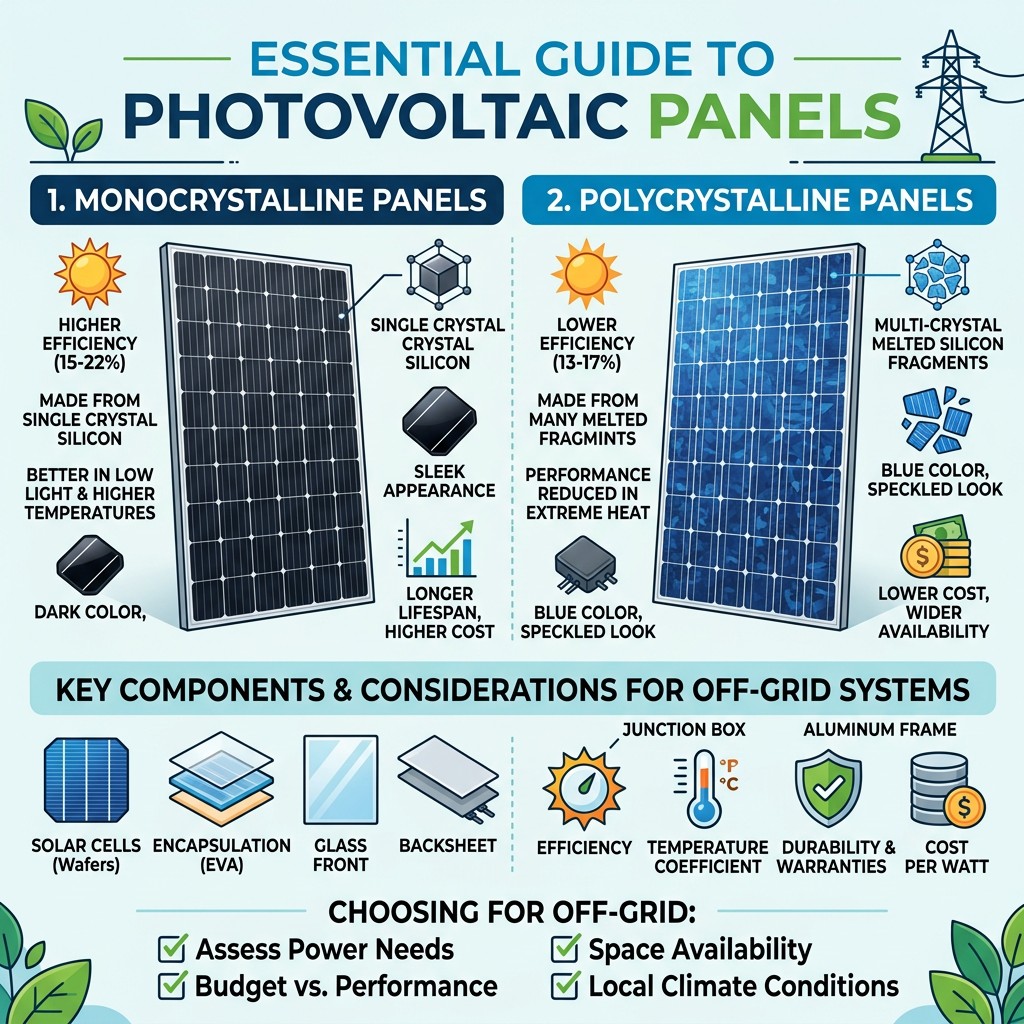
In the Nigerian market, you will primarily encounter two types of solar panel technologies: Monocrystalline and Polycrystalline. For off-grid systems, the choice is clear: Monocrystalline is the superior investment.
Monocrystalline panels are made from a single, high-purity silicon crystal. This structure allows electrons to move more freely, resulting in higher efficiency rates—often exceeding 21-22%. In contrast, polycrystalline panels are made from multiple silicon fragments melted together, which makes them slightly less efficient (typically 15-17%). While polycrystalline panels may have a lower upfront cost, they require more roof space to generate the same amount of power. In an off-grid system where you need to maximize energy harvest to charge your battery bank, the high efficiency of monocrystalline panels is invaluable.
2. The Importance of Temperature Coefficient
One of the most overlooked factors in selecting solar panels for Nigeria is the “temperature coefficient.” Nigeria’s tropical climate means that solar panels are often exposed to extreme heat. It is a common misconception that heat improves solar production; in reality, solar panels lose efficiency as their temperature rises.
High-quality monocrystalline panels have a lower temperature coefficient than budget alternatives. This means they experience a smaller drop in power output during the blistering midday sun. For an off-grid user, this stability is crucial. You need your panels to be performing at their peak during the hottest hours to ensure your lithium batteries are fully charged before the sun goes down. Investing in panels with superior heat tolerance ensures that your energy yields remain high even in the hottest regions of the country, from Lagos to Maiduguri.
3. Durability and Resistance to Local Environmental Factors
An off-grid solar system is a long-term financial commitment, and your panels must be built to last. Nigeria’s environment presents unique challenges, including heavy rainfall, high humidity, and the annual Harmattan dust. Your PV panels must be resistant to “Potential Induced Degradation” (PID) and salt mist corrosion, especially if you live in coastal areas like Lekki or Port Harcourt.
Furthermore, the glass used in the panels should be tempered and high-transparency to allow maximum light penetration while protecting the delicate silicon cells from physical impact. Look for panels that come with at least a 25-year performance warranty. This warranty is your assurance that the manufacturer stands behind the durability of their product and that your investment will continue to pay off for over two decades.
4. Matching Panels with Your Battery and Inverter
Selecting the right panels also involves ensuring they are compatible with the rest of your off-grid equipment. The “Maximum Power Voltage” (Vmp) and “Open Circuit Voltage” (Voc) of your panel array must fall within the input range of your solar charge controller or hybrid inverter. In modern off-grid systems, using MPPT (Maximum Power Point Tracking) technology is essential. MPPT controllers can “squeeze” the maximum amount of power out of your panels, even in low-light conditions or during hazy Harmattan days, and convert it into the optimal voltage for charging your battery bank.
5. Maintenance for Long-Term Performance
Even the best solar panels require a basic maintenance routine to ensure they continue to perform at their peak. Dust accumulation is the primary enemy of solar efficiency in Nigeria. A thin layer of dust can reduce your energy output by 10-20%. For off-grid systems, where every watt counts, regular cleaning with soft brushes and clean water is mandatory. We recommend a monthly cleaning schedule, or more frequent cleanings during the dry season, to ensure that nothing blocks the sun’s rays from reaching your PV cells.
Conclusion: Powering Your Future with Confidence
Transitioning to an off-grid solar power system is a bold and rewarding step toward energy independence. By selecting high-efficiency monocrystalline panels with excellent temperature coefficients and robust durability, you are securing a reliable source of clean energy for your home or business. At Twerd, we specialize in providing Tier-1 solar panels and integrated energy storage solutions designed to withstand the Nigerian climate and deliver optimal ROI.
Are you ready to take control of your energy future? Visit Twerd.ng today to explore our range of high-performance solar solutions and start your journey toward a brighter, more sustainable Nigeria.